THE JAPANESE CHEF'S CHOICE MEAL THAT GREW FROM EDO'S SUSHI STALLS INTO A GLOBAL COUNTER FORMAT

Omakase dining is a Japanese format in which the guest leaves the choice of dishes to the chef. The word translates as "I leave it up to you", and Britannica notes that it also names the meal itself: usually a series of small sushi servings or courses, eaten at the counter for a fixed price. The chef decides on the day what to serve, according to the quality and season of the ingredients. According to Britannica, the word was coined in 1967 and attached to sushi dining in the 1990s, but the format it describes is older. It rests on edomae sushi, the hand-formed nigiri that Edo, now Tokyo, sold from street stalls in the early 19th century, and on the sushi counter, where the chef forms each piece in front of the guest. The Japan National Tourism Organization describes omakase as usually the most expensive way to eat at a sushi restaurant, and says reservations are essential.
WHAT DOES OMAKASE MEAN?

In The Story of Sushi, quoted by the MICHELIN Guide, the writer Trevor Corson describes omakase as what a sophisticated customer says to the chef at the sushi bar. Connoisseurs seldom ordered from a menu, and traditional sushi bars in Japan often had none. The meal that follows depends on the chef's philosophy and the ingredients of the day, so omakase at two restaurants can differ widely. Britannica describes it as long and leisurely, with the chef watching each diner's reactions and adjusting what comes next, and notes that it may include alcoholic drinks chosen to suit the dishes. The Japan National Tourism Organization suggests sake served chilled in summer and heated in winter.
Omakase is often compared with kaiseki, the traditional Japanese multi-course meal. Britannica defines kaiseki as a set, seasonal menu in which each course is prepared in a different way, and the MICHELIN Guide describes it as highly ritualised, following a fixed rhythm. Omakase changes from one occasion to the next, and the chef may decide what to cook in the middle of the meal. Britannica records that in Japan the word omakase is used well beyond sushi, for chef-chosen lunches, wine and cocktails, and even for hairstyles, clothing and holidays.
WHERE DID SUSHI COME FROM? FROM NAREZUSHI TO EDOMAE

Sushi began as a way of preserving fish. The Japan National Tourism Organization traces it to the rice paddies of the Mekong Delta, where farmers packed fish with salt and rice to ferment it and then threw the rice away. The method, now called narezushi, reached Japan with rice cultivation, and funazushi is a form of it still made today. Until around the Muromachi period the fermented rice was discarded; later, people began to eat it with the fish. By the Edo period, when Edo had more than a million inhabitants, cooks had developed hayazushi, or fast sushi: balls of vinegared rice topped with ingredients such as egg or raw fish.
From the early 1800s, according to Nippon.com, Edo replaced hakozushi, sushi pressed in a box, with nigirizushi, shaped by hand. The regions also favoured different fish: Kyoto and Osaka pressed mackerel, while Edo preferred the smaller kohada, or gizzard shad. The MICHELIN Guide explains the methods behind what became edomae sushi. Seafood from Tokyo Bay could not be refrigerated, so fish were salted, simmered, marinated in soy sauce or cured in vinegar, then served over rice at harbour stalls near old Edo. Sushi prepared this way became the city's popular fast food, and only the arrival of iceboxes shifted tastes towards raw fish.
HANAYA YOHEI AND THE SUSHI STALLS OF EDO

Tradition credits the invention of nigiri to Hanaya Yohei. The writer Kobayashi Akira, in an article for Nippon.com, states that Hanaya created the form around 200 years ago, but he cites no contemporary record, and the attribution is best treated as the traditional account rather than a documented fact. In Kobayashi's telling, Hanaya first sold kohada sushi at night from okamochi, wooden carrying boxes, then moved to a yatai, a small street stall. Kobayashi compares the stall to a fast-food outlet and describes it as a forerunner of the conveyor-belt sushi restaurant.
Yatai suited Edo because its crowded districts left little land for shops. Customers chose a topping from the display and the chef made the sushi on the spot, and stalls also appeared at seasonal events such as the nijūrokuya-machi festival in Takanawa. Kobayashi lists the toppings as kohada, shirauo (icefish), shrimp, sweet anago (conger eel), tuna and tamagoyaki, a rolled omelette. A piece cost 8 mon, which he puts at under ¥100 in today's money, and tamagoyaki cost 16 mon because eggs were expensive. The stall proved too small, and in 1824 Hanaya opened a shop in Ryōgoku. It lost customers after the Great Kantō Earthquake of 1923 and closed in 1930.
HOW DOES A SUSHI OMAKASE WORK?

Like other forms of chef's table dining, edomae sushi is typically served at a counter. The Japan National Tourism Organization describes the chef slicing the fish and forming each nigiri after the order, then serving it at once, and notes that some highly rated restaurants have as few as eight counter seats. The word sushi combines su, vinegar, and meshi, rice. The rice, shari, is slightly sweet and seasoned with vinegar, and connoisseurs judge it by the balance of vinegar and sugar, the amount packed into each piece and its firmness. JNTO calls the rice the key to a chef's style.
At Sushi Sho in New York, the MICHELIN Guide describes an omakase of tsumami, small dishes, alternating with nigiri, after which guests may order further pieces à la carte. The preparation draws on the old preservation methods: tuna is rested for days until it turns a pale grey and gains an acidity that suits the vinegared rice, sea urchin is firmed in a bath of alum and water, and kohada is salted and then cured in vinegar. Nobu Yamazaki of Sushi Taro in Washington, D.C. starts with a few appetisers to read a diner's reaction before moving to more adventurous dishes, while Tatsuya Sekiguchi of Omakase Room by Tatsu in New York serves a set sequence of 18 pieces.
In 2018, Tokyo's main fish market moved. Nippon.com reports that Tsukiji, which had served as Japan's kitchen for 83 years, closed on 6 October 2018, and that trucks and carts carried its business to the new Toyosu market in the early hours of 7 October. Toyosu opened on 11 October. It covers 400,000 square metres, 1.7 times the area of Tsukiji. On the first morning, Governor Koike Yuriko attended the first tuna auction shortly after 5 in the morning. Sushi restaurants that had operated inside Tsukiji moved to Toyosu with the market.
OMAKASE ETIQUETTE AT THE SUSHI COUNTER
In a 2024 MICHELIN Guide feature, the writer Kat Odell collected advice from omakase chefs in the United States. Punctuality comes first: late arrivals disrupt the counter, and the chef may not serve courses a guest has missed. Dietary restrictions should be declared when booking, because menus are built around seasonal ingredients and a fixed number of seats. Phones, keys and bags should stay off the wooden counter. An oshibori, a hand towel, is given at the start of the meal, and a second may be offered to refresh the fingers between pieces of nigiri.
Nigiri can be eaten with the hands, since chopsticks may break the rice, and each piece is meant to be eaten whole in one bite. Kazushige Suzuki of Icca in New York advises eating each piece straight away, because it is made to be eaten at its ideal temperature. Gari, pickled ginger, is a palate cleanser between pieces rather than a snack, and Eiji Ichimura of Sushi Ichimura asks diners to avoid smoking and strong perfume, which can mask the aroma and flavour of the sushi.
JIRO ONO AND THE MICHELIN GUIDE TOKYO

Michelin published its first guide to Tokyo in November 2007. The Japan Times reported that eight restaurants received the top rating of three stars: the Japanese restaurants Kanda, Koju and Hamadaya, the French restaurants Quintessence, Joel Robuchon and L'Osier, and two sushi restaurants, Sukiyabashi Jiro and Sushi Mizutani. Jean-Luc Naret, director of the MICHELIN Guide, said the quality of Japanese restaurants had brought many surprises, and he described Tokyo as one of the world's shining gastronomic cities. AFP later reported that Sukiyabashi Jiro had held three stars every year since 2007.
Sukiyabashi Jiro is a basement restaurant in Ginza that opened in 1965 and seats up to 10 guests at a time. Its chef, Jiro Ono, runs it with his eldest son, Yoshikazu, and his younger son runs a branch in Roppongi Hills. The restaurant was the subject of the 2011 documentary Jiro Dreams of Sushi, and in 2014 the then US President Barack Obama dined there with Prime Minister Shinzō Abe during trade talks. In 2019 its chef's selection started at ¥40,000.
OMAKASE BEYOND JAPAN: PRICES AND RESERVATIONS
By the time Keiji Nakazawa opened Sushi Sho in Midtown Manhattan in 2024, the MICHELIN Guide notes, the edomae style had been widely adopted by leading omakase restaurants around the world. Nakazawa began training as a teenager, worked in more than 20 restaurants across Japan and opened his own restaurant in Tokyo in 1989. Sushi Sho, a horseshoe-shaped counter with carvings of two founding figures of the cuisine at either end, received three stars at the 2025 Northeast Cities ceremony. In March 2026 the guide described it as the only sushi restaurant in the United States with that rating.
Price is part of the format's reputation. Britannica puts omakase meals at up to $800, with options at around $200 or less, and notes that many restaurants have no menu and do not list a base price. The MICHELIN Guide notes that some chefs publish a base price and charge a supplement for extra courses. Getting a seat can be harder than paying for it. In November 2019, AFP reported that Sukiyabashi Jiro had been left out of the MICHELIN Guide Tokyo 2020 because it no longer accepted reservations from the general public. Seats went to regular customers, people with connections or guests booking through the concierge of a leading hotel. A Michelin spokeswoman said the policy placed the restaurant outside the guide's scope and that it was wrong to say it had lost its stars. The Roppongi branch, which accepts public reservations, kept its two stars.
OMAKASE, THE IZAKAYA AND THE AUBREY AT MANDARIN ORIENTAL HONG KONG
Omakase and the izakaya are both forms of Japanese dining culture, and both trace back to the way Edo ate out. Writing in Kikkoman's Food Forum, Noritake Kanzaki describes how drinking out in Edo began at yatai, stand-up stalls serving dishes such as soba noodles, dengaku and nishime. Niuri-sakaya, shops selling sake with simmered dishes, emerged in the early 18th century, and late in that century they became the origin of today's izakaya. Hanaya Yohei's sushi stall belonged to the same yatai trade.
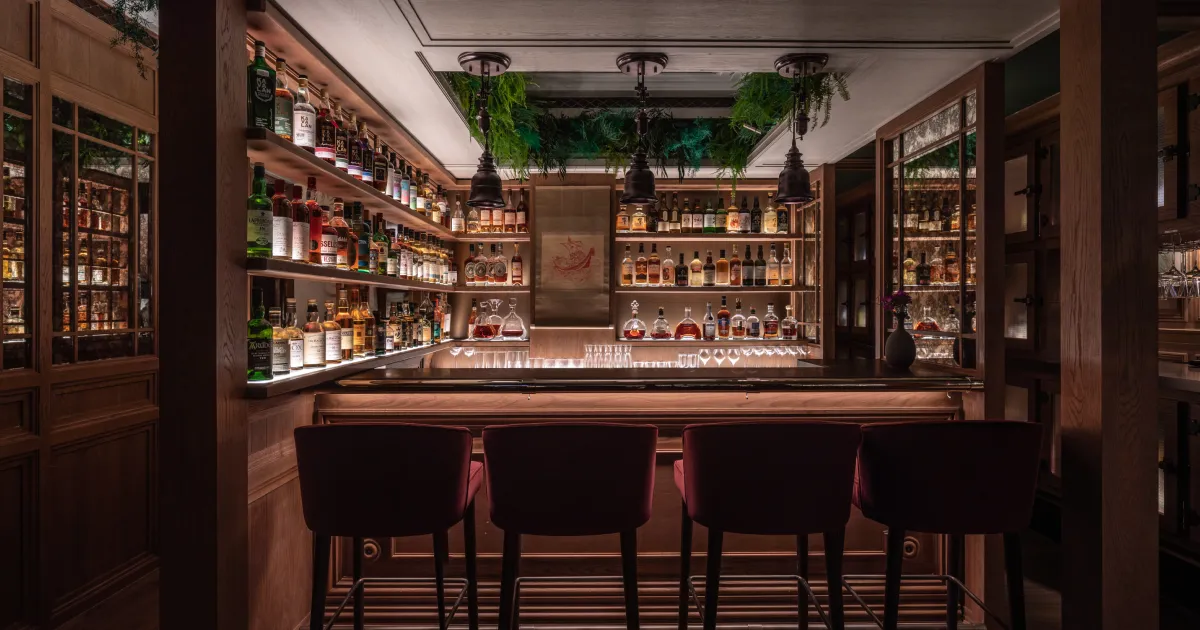
The Aubrey is a Japanese izakaya and bar on the top floor of Mandarin Oriental Hong Kong, designed by Silverfox Studios and completed in 2021. Its concept is an eccentric English gentleman's manor in which a collector's obsession with all things Japanese shapes every element. It is named after the illustrator Aubrey Beardsley and draws on Japonisme and ukiyo-e motifs: Mount Fuji, a pagoda, torii gates and crashing waves. The interior combines dark timber panelling, gilded picture frames and gallery walls, and a curio lounge holds objets d'art in bespoke display cabinetry.
SOURCES
- Britannica Omakase
- MICHELIN Guide Kitchen Language: What Is Omakase?
- Nippon.com When Sushi Became a New Fast Food in Edo
- Japan National Tourism Organization Sushi in Japan Guide
- MICHELIN Guide A Legendary Sushi Master Helping to Revive the Once-Forgotten Edomae Technique
- MICHELIN Guide 14 Pro Sushi Tips From America's Top Omakase Chefs
- Nippon.com Japan's New "Kitchen": Famed Tsukiji Market Relocates to Toyosu
- The Japan Times Michelin names Tokyo gourmet capital
- Malay Mail (AFP) Famed Tokyo sushi restaurant Jiro left dreaming of Michelin stars
- Kikkoman Food Forum Sake in Japanese Food Culture: The Edo Culture of Eating and Drinking Out